You’ve got marketing vendors lining up to take your money. The TV ad rep promises prime-time exposure. The Google Ads specialist swears digital is the only way. Your neighbor’s cousin does direct mail and says nothing beats a postcard in the hand. Meanwhile, you’re just trying to figure out where your next HVAC install or roofing job is coming from.
Here’s the truth: there’s no single “right” marketing channel for home service businesses. The right answer depends on your customers, your goals, and your budget. But there IS a wrong way to choose—and most business owners are doing it.
DW Creative helps home service businesses grow by building strong connections between their brands and the homeowners they serve.
By reading this article, you will learn how to evaluate marketing channels based on your customers’ behavior, match channels to your specific business goals, avoid common vendor pitches that waste money, and build a marketing mix that actually works for your budget.
Start With Your Customer, Not the Channel
Most business owners choose marketing channels backward. They start with what’s available or what a vendor is selling, then hope their customers show up. That’s like opening a restaurant in a building you already own instead of choosing a location where hungry people actually go.
The first question isn’t “Should I advertise on TV or Google?” It’s “Where do my customers spend their attention?”
For home service businesses, your customers are homeowners. But not all homeowners consume media the same way. A 35-year-old first-time homeowner looking for lawn care services behaves completely differently than a 65-year-old homeowner who needs a new furnace.
Map Your Customer’s Media Day
Think about your ideal customer. When do they wake up? What do they look at first—their phone, the TV, or nothing? During their commute, are they listening to radio or a podcast? At work, are they scrolling Facebook or focused on tasks? In the evening, are they watching cable news or streaming Netflix? To see this in practice, view our homeowner media research and you’ll see first-hand how different segments use media on a daily basis.
You don’t need a research study. You need honest observation. If you’re targeting busy parents in their 30s and 40s, they’re probably not watching daytime TV. If you serve retirees, they’re probably not scrolling TikTok.
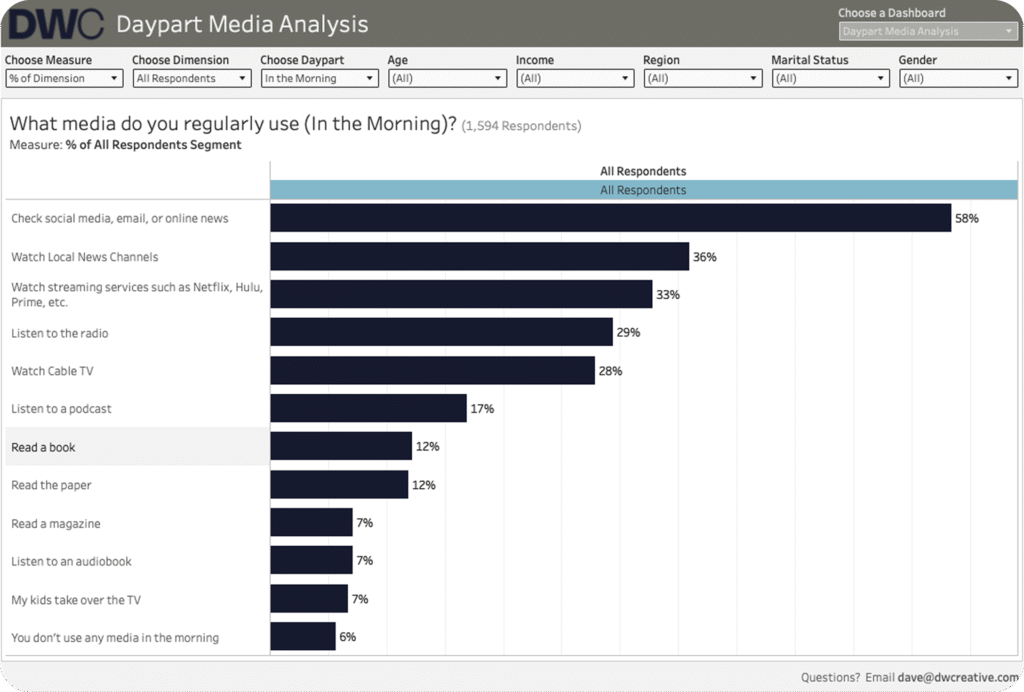
Media consumption habits should drive your channel selection, not the other way around.
Consider the Homeowner’s Mindset
There’s a difference between browsing and searching. Someone scrolling Facebook is in entertainment mode—they’re not looking for a roofer. Someone typing “emergency HVAC repair near me” into Google at 10 PM is in crisis mode—they need help now.
Your marketing channel needs to match the mindset. Some channels are great for building awareness when homeowners aren’t actively looking. Others excel at capturing demand when homeowners are ready to buy.
Match Marketing Channels to Your Business Goals
Not every marketing channel serves the same purpose. TV builds broad awareness. Google Ads captures immediate demand. Direct mail can do both, depending on how you use it. If you don’t know what you’re trying to accomplish, you can’t choose the right tool.
Awareness vs. Conversion Goals
Awareness channels introduce your brand to homeowners who don’t know they need you yet. These include TV, radio, display ads, social media ads, and brand-focused direct mail such as a quarterly newsletter. They work best when you have a longer sales cycle or when homeowners need to remember you months before they’re ready to buy.
For example, a remodeling company might use TV advertising to stay top-of-mind with homeowners who are thinking about a kitchen renovation but won’t pull the trigger for another six months.
Conversion channels capture homeowners who are actively looking for your service right now. These include Google Search ads, local service ads, lead-aggregators and emergency-focused direct mail. They work best when homeowners have an immediate need and you can respond quickly.
An HVAC company running Google Ads for “furnace repair” is capturing conversion demand. The homeowner already knows they need help—they just need to choose who to call.
Most successful home service businesses need both. You need awareness to fill your pipeline for the future, and you need conversion channels to keep your schedule full today.
Budget Size Matters
Your marketing budget determines which channels make sense. A $2,000 monthly budget can’t support a meaningful TV presence, but it can fund a solid Google Ads campaign. A $20,000 monthly budget opens up TV and allows for multi-channel testing.
Here’s a rough guide by budget size:
$1,000-$3,000/month: Focus on high-intent digital channels. Google Search ads, local service ads, and targeted Facebook ads for your geographic area. Add basic SEO and Google Business Profile optimization. Skip TV and broad awareness plays—you don’t have enough reach to make an impact.
$3,000-$10,000/month: You can start mixing awareness and conversion. Continue with Google and local service ads, but add direct mail to your service area. Test display advertising or streaming TV to stay visible. Begin building a content strategy for long-term SEO value.
$10,000-$25,000/month: Multi-channel strategies become effective. TV advertising (connected TV or local broadcast) can work if your market isn’t oversaturated. Layer in direct mail, digital, and retargeting. You have enough budget to test and optimize across channels.
$25,000+/month: Full-funnel marketing is possible. Brand building through TV, awareness through direct mail and display, conversion through search and local services, and sophisticated retargeting to stay in front of prospects. You can afford to play the long game while still capturing immediate demand.
Don’t stretch your budget across too many channels. It’s better to dominate one or two channels than to dabble in five and make no impact in any.
Test Before You Commit
Marketing vendors want long-term contracts. They’ll tell you that “you need six months to see results” or “brand building takes time.” Sometimes that’s true. Often it’s just a sales tactic to lock you in before you realize the channel doesn’t work for your business.
How to Test New Channels Smartly
Start with a pilot campaign—a short-term test with clear success metrics. For digital channels, that might be 60-90 days. For direct mail, test one or two drops before committing to a monthly schedule. For TV, buy a short flight during a relevant season (like HVAC during summer or roofing after storm season).
Define what success looks like before you start. If you’re running Google Ads, you need to know your target cost per lead and acceptable close rate. If you’re testing direct mail, you need to track response rates by offer and neighborhood. If you’re trying TV, you need a way to measure lift in branded search and incoming calls.
Here’s the key: track everything. Use unique phone numbers for each channel. Use specific landing pages. Ask every caller, “How did you hear about us?” Don’t rely on “we’re just busier this month”—that’s not data.
Red Flags From Marketing Vendors
You’ll hear a lot of promises from marketing vendors. Some are legitimate. Some are designed to separate you from your money. Here are red flags that should make you pause:
“You need to commit to 12 months to see results.” Long-term consistency matters for brand building, but you should see some positive indicators within 90 days. If a vendor won’t let you test their channel with a shorter commitment, they’re more confident in their contract than their results.
“TV/Digital/Direct Mail is dead—only [our channel] works now.” Anyone telling you all other channels are obsolete is selling you something. Different channels work for different businesses. Beware of absolute statements.
“We’ll get you to page one of Google in 30 days.” SEO doesn’t work that way. Neither does legitimate brand building. Quick wins usually mean shortcuts that will hurt you later.
“Our proprietary algorithm/system/platform is better than everyone else’s.” Most marketing vendors use the same platforms you could access yourself (Google, Meta, programmatic TV networks). The value is in strategy and execution, not secret technology.
“You can’t track direct mail/TV/brand advertising.” It’s harder than tracking digital clicks, but it’s absolutely possible. If a vendor tells you to “just trust the process” without offering any measurement framework, run.
Build a Channel Mix That Works Together
The most effective marketing strategies use multiple channels that reinforce each other. Someone sees your truck in their neighborhood, then sees your direct mail piece, then searches for you when they need your service. That’s how real homeowner decision-making works.
The Awareness-to-Conversion Funnel
Think of your marketing channels in stages. Top-of-funnel channels introduce your brand: TV, radio, display ads, social media, direct mail with brand messaging. Middle-of-funnel channels nurture interest: retargeting ads, email marketing, educational content, direct mail with offers. Bottom-of-funnel channels capture ready-to-buy homeowners: Google Search ads, local service ads, emergency direct mail.
You don’t need to be everywhere, but you should have at least one channel at each stage if your budget allows. A roofing company might use direct mail for top-of-funnel awareness, retargeting ads to stay visible to website visitors (middle funnel), and Google Ads to capture “roof repair near me” searches (bottom funnel).
The Power of Retargeting
Most homeowners won’t hire you the first time they encounter your brand. They’ll visit your website, get distracted, and forget about you. That’s where retargeting becomes critical.
Retargeting shows ads to people who have already visited your website or engaged with your content. It works across display networks, Facebook, Instagram, and YouTube. It’s relatively inexpensive and keeps your brand visible while homeowners are still in decision mode.
For home service businesses with longer sales cycles—like remodeling, replacement windows, or major HVAC installs—retargeting is one of the highest-ROI tactics available.
When to Say No to a Marketing Channel
Knowing what NOT to do is just as important as knowing what to do. Some channels won’t work for your business no matter how much money you throw at them.
Say no to channels your customers don’t use. If your ideal customer is young homeowners, daytime cable TV is probably a waste. If you serve retirees, TikTok ads won’t help you.
Say no to channels you can’t afford to test properly. A $500 TV buy won’t move the needle. A $300 Facebook ad budget split across five audiences won’t give you useful data. It’s better to fully fund one channel than to underfund three.
Say no to channels you can’t support operationally. If you run Google Ads but don’t answer your phone after 5 PM, you’re wasting money on evening searches. If you send direct mail but your website looks like it’s from 2005, you’ll lose credibility. Your marketing is only as good as the customer experience that follows.
Next Steps for Choosing Your Marketing Channels
Choosing the right marketing channels doesn’t have to feel overwhelming. Follow these steps to make confident decisions:
- Profile your ideal customer’s media habits. Where do they spend their time? When are they most receptive to messages? What mindset are they in when they encounter your marketing?
- Clarify your marketing goal. Are you building long-term brand awareness or capturing immediate demand? Your goal determines which channels make sense.
- Match your budget to realistic channels. Don’t spread yourself too thin. It’s better to dominate one or two channels than to dabble ineffectively in many.
- Test with clear success metrics. Define what success looks like before you start, track every lead source, and give each test enough time and budget to produce meaningful data.
- Build a multi-channel mix as you grow. Start with conversion channels to keep your schedule full, then add awareness channels to build your pipeline for the future.
DW Creative is an agency committed to empowering homeowner-focused businesses. If you want help evaluating which marketing channels make sense for your business and budget, schedule a fit call with our team to see how DW Creative can help.
If you’re not ready to make a commitment or want to learn more about marketing strategy, we recommend the following articles: